Renovate or Build New Commercial Space? A Cost Reality Check
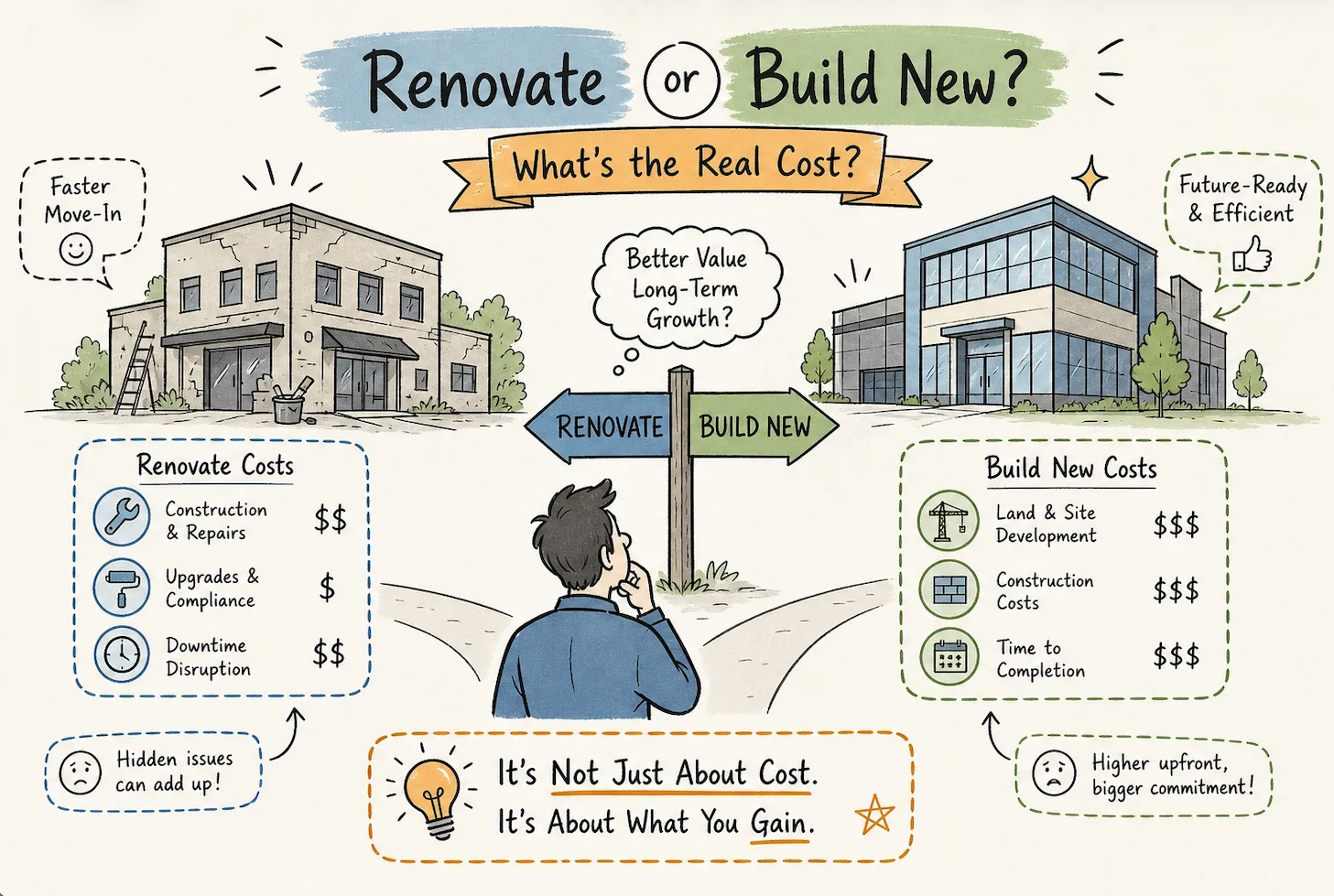
You're staring at two options. One involves gutting a building you already have. The other means breaking ground on something new. Both quotes came back higher than you expected, and the more you look at the line items, the less sure you are which direction actually saves money. If you're asking whether it's cheaper to renovate an office or build new commercial space, you're asking the right question, and it's one of the most common conversations we have with clients at Ascension Construction. After working through this decision with dozens of Central Indiana businesses, the honest answer is: it depends on factors that don't show up in the initial quote.
This article gives you real 2026 cost ranges for the Midwest, a clear look at what the numbers hide, a timeline comparison that accounts for business downtime, and a practical checklist to identify which path fits your situation. No guesswork, no vague advice. Just the data you need to make a procurement-ready decision.
Is it cheaper to renovate an office or build new commercial space? What the numbers actually show
The Midwest is a favorable cost environment compared to coastal markets, and Indiana sits right in that value zone. That context matters when you're reading national headlines about construction costs, because those numbers often reflect New York or California projects that have nothing to do with an Indianapolis office build-out.
The renovation cost spectrum in the Midwest
Commercial renovation in the Midwest breaks into three tiers, and the tier you land in is determined almost entirely by how much of the existing building's systems you touch. Basic cosmetic work, new paint, flooring, lighting, and minor repairs, runs $50 to $100 per square foot across all U.S. regions, including Indiana. Mid-range renovation covers demolition, non-structural wall reconfiguration, millwork, and restroom updates, landing at $100 to $200 per square foot. At the high end, a gut renovation involving full interior demolition plus replacement of HVAC, electrical, and plumbing runs $260 to $720 per square foot in the Midwest.
For most Indiana office renovation projects, you're looking at $100 to $300 per square foot depending on scope. A project crosses into the high-end tier the moment you start touching major mechanical systems, especially in buildings over 20 years old where those systems are already past their service life. Class A Indianapolis office spaces are averaging around $168 per square foot in 2026, with premium build-outs exceeding $250. Tenant improvement (TI) costs for leased spaces follow a similar range, though landlord TI allowances can offset a meaningful portion of that investment depending on the deal structure. For a deeper look at the assumptions that drive contractor estimates and what questions to ask before committing, see 12 Questions to Ask Before Starting a Commercial Renovation, Indiana Construction | Ascension.
New ground-up construction in the Midwest
New construction splits into shell cost and finished cost, and conflating the two is where a lot of budget conversations go sideways. A bare pre-engineered metal building shell on a slab runs $14 to $30 per square foot. That number sounds cheap until you realize it doesn't include HVAC, electrical, restrooms, or finishes. A fully finished office with all those systems runs $50 to $100 per square foot nationally, with the Midwest sitting at or slightly below that range. Soft costs, design, permits, and engineering fees, add another 15 to 30% on top of hard construction costs. For broader national benchmarks on commercial construction cost per square foot and how they compare regionally, consult this analysis of commercial construction cost per square foot.
Why the sticker price doesn't settle the debate
At face value, a mid-range renovation and a finished new build can look almost identical on a per-square-foot basis. A $150 per square foot renovation quote and a $175 per square foot new build quote feel like they're in the same neighborhood. The real cost difference lives in what those numbers don't show: hidden conditions in existing buildings, timeline-driven business disruption, and tax implications that shift the long-term math. The next two sections cover exactly that.
Hidden renovation costs that can quietly flip your budget
The gap between a renovation estimate and a renovation final invoice is almost always explained by what the walls were hiding. In buildings 20 to 40 years old, which describes a large portion of Central Indiana's commercial inventory, pre-demo conditions routinely surface environmental and structural issues that weren't visible during the initial site walk. For more examples of common surprises owners overlook in retail and commercial remodels, refer to The Hidden Costs of Retail Renovations: What Most Store Owners Don't Budget For, Indiana Construction | Ascension.
What older buildings hide before demo begins
Environmental abatement is frequently encountered in older Indiana buildings, and experienced contractors treat pre-demolition testing as standard practice rather than an optional add-on. Asbestos removal runs $1,192 to $3,255 on average. Lead paint abatement lands in a similar range. Knob-and-tube wiring replacement, required for code compliance when discovered, can reach $12,000 to $36,600 depending on building size. None of these show up on a pre-bid estimate unless the building has already been tested and cleared. Adaptive reuse and retrofit projects carry the highest abatement exposure because they typically involve older structures with more accumulated deferred maintenance.
Structural issues compound the problem. Water intrusion, foundation settlement, and beam deterioration are common in Midwest commercial buildings where freeze-thaw cycles accelerate concrete decay year over year. Foundation repair can run anywhere from $2,218 to $8,112 for moderate issues, with major structural problems exceeding $25,000. Water damage remediation adds another $1,361 to $6,270 before any reconstruction begins. For a focused discussion of frequently overlooked structural issues in commercial buildings, see Five Common Structural Issues in Commercial Buildings.
Code compliance upgrades you didn't see on the drawings
Some jurisdictions apply a substantial-improvement threshold, often in the range of 50% of a building's assessed value in certain localities, that can trigger broader code compliance requirements across the entire space. Requirements vary by municipality, so checking with your local building department early is essential. When triggered, these rules can require updated electrical service, ADA upgrades, fire suppression systems, and HVAC efficiency standards, even if those systems weren't part of your original scope. These upgrades can add 5 to 15% to the total project budget. For a full gut renovation in Indiana, MEP system replacement alone runs $150 to $200 per square foot.
The contingency rule experienced owners use
Budget a 10 to 20% contingency on any renovation project, non-negotiable. In buildings more than 25 years old, 20% is the floor, not the ceiling. New construction carries significantly less contingency risk because site conditions are established before a shovel goes in the ground. You're not discovering unknown conditions mid-project; you're building to a known specification. That predictability has real dollar value that doesn't appear on a per-square-foot comparison. For more on where owners often miss major cost drivers, review The Most Overlooked (and Most Expensive) Part of a Commercial Build-Out, Indiana Construction | Ascension.
Timeline comparison and what business downtime actually costs you
Timeline is often the deciding factor, not the construction cost itself. A project that takes four extra months to complete while your team is working in a cramped temporary space has a financial impact that should appear as a line item in your decision analysis.
How long each path takes by project size
For small projects in the 2,500 to 5,000 square foot range, renovation and new construction are roughly comparable: renovation typically runs 3 to 5 months, while a new build runs 3 to 6 months. The calculus shifts significantly at larger scales. A mid-size project in the 20,000 to 50,000 square foot range takes 4 to 8 months to renovate versus 9 to 15 months to build new. At 100,000 square feet and above, renovation runs 8 to 14 months while new construction stretches to 24 to 36 months or more. For most small to mid-size Indiana businesses, renovation is faster. For larger projects, that timeline gap is a major ROI factor.
Indianapolis permitting is more efficient than the statewide average. Standard commercial projects, both renovations and new builds, are reviewed same-day by the city. Complex projects requiring full plan review take 5 to 20 days for initial review, with subsequent correction cycles adding another 5 to 10 business days each. That's still faster than the 4 to 8 week timeline typical of general Indiana commercial permitting, which is an advantage worth factoring into your schedule. If you need a quick primer on local requirements and permit expectations, see this guide to Indianapolis building permits.
Putting a dollar figure on downtime
Office closure during construction carries a real cost that varies significantly by business size and revenue profile. For a mid-size office, productivity loss, fixed overhead, and temporary relocation expenses can range from $20,000 to $50,000 per week, though the actual figure depends on your headcount, lease obligations, and whether partial operations remain possible. Phased construction schedules reduce this exposure but extend the overall timeline. New construction has a structural advantage here: your existing space operates fully until move-in day, with zero construction disruption to your current team. For businesses that can't absorb partial closures, that operational continuity is worth real money, and it belongs in the comparison.
Tax and ROI factors that change the real bottom line
Construction cost is only part of the financial picture. The tax treatment of your project can shift the effective cost by thousands of dollars over the first few years of ownership, and most business owners don't factor this in during the planning phase, which limits their options.
Property tax reassessment: renovation vs. new build
In Indiana, both new construction and major renovation trigger an out-of-cycle assessment using the cost approach, where the state establishes a standard construction cost per square foot and applies it to determine your property's new taxable value. The key distinction: new construction is assessed at full current market value from day one, while renovation is assessed only on the incremental value of the improvement. For building owners, renovation projects also qualify for tax abatements in certain Indiana jurisdictions that can protect the pre-renovation assessed value for the duration of the exemption period. Before committing to either path, a conversation with a tax advisor about your local abatement options is worth the time.
Bonus depreciation and Section 179 in 2026
Under the current tax framework, 100% bonus depreciation is permanently restored for qualifying property acquired after January 19, 2025. For renovation projects, interior improvements classified as Qualified Improvement Property (QIP) fully qualify for that immediate deduction, since QIP has a 15-year recovery period that falls within the eligibility threshold. Section 179 expensing now covers up to $2.5 million in qualified improvements including HVAC, electrical, and security upgrades for both project types. For detailed guidance on the 100% bonus depreciation rules and how they apply to improvements, consult a tax professional and current guidance.
New construction is more complex: the building structure itself carries a 39-year recovery period and doesn't qualify for bonus depreciation, though shorter-life assets inside the building, equipment, furniture, HVAC, and lighting, do qualify. One timing factor worth flagging: the Section 179D energy efficiency deduction terminates for construction begun after June 30, 2026. If energy-efficient systems are part of your project scope, this is a closing window that affects the net cost of both renovation and new construction.
When renovation delivers stronger ROI
Renovation tends to deliver stronger ROI when you're working with a structurally sound building, the existing layout serves a majority of your operational needs, and your project scope stays below the major MEP replacement threshold. You avoid land acquisition costs, benefit from tax protection on the pre-existing assessed value, and capitalize on a familiar location that already has customer and employee recognition. New construction wins when the existing structure carries significant deferred maintenance, major environmental liabilities, or layout constraints that cost more to fix than to build from scratch. Adaptive reuse projects, converting older structures to new commercial uses, can fall into either category depending on the building's condition and how much of the original footprint and systems can be retained.
Renovate or build new: a practical checklist to pick the right path
Four diagnostic questions get most Indiana business owners to a clear answer faster than any cost spreadsheet.
Four questions that point to the right answer
- How old is the building, and has it had a recent inspection? Age and current condition are the strongest predictors of hidden cost risk. A building inspection report is the single most valuable document you can have before a contractor gives you a renovation estimate.
- What percentage of the existing structure actually works for your layout? If less than 60% of the existing footprint, mechanical systems, and layout are usable as-is, the renovation math starts moving toward new construction territory. Think of this as a rule of thumb rather than a hard cutoff, every building is different, and a qualified contractor assessment will give you a more precise read.
- Can your business tolerate a phased closure, or do you need full operational continuity until move-in? Businesses that can't absorb construction disruption have a strong structural argument for new construction.
- How much budget flexibility do you have for surprises? Renovation carries materially more contingency risk than new construction. If your budget is fixed and surprises would be disqualifying, that risk profile matters.
The break-even logic: when new construction wins
As a general rule of thumb used across the industry, when a renovation quote approaches 70 to 80% of the cost to build new, the calculus often favors the new build. The reasoning is risk-adjusted: renovation at that price point still carries hidden cost exposure, while new construction at a similar price locks in a known scope with far fewer unknowns. To illustrate the math: a 5,000 square foot gut renovation in Indianapolis at $350 per square foot totals $1.75 million. A comparable new build, using a hypothetical finished cost of $200 per square foot for a higher-specification office in this scenario, totals $1 million before land. If land acquisition runs $300,000 to $400,000, you're at $1.3 to $1.4 million for the new build, with a more predictable cost trajectory and no hidden condition exposure. Note that actual new-build costs vary widely based on finish level and site conditions; your contractor should build a site-specific estimate rather than relying on any single benchmark figure.
How Ascension Construction helps Indiana businesses navigate this decision
The most common frustration we hear from Indiana business owners evaluating these two paths is receiving wildly different quotes with no explanation for why the numbers diverge. A $120 per square foot estimate and a $280 per square foot estimate for the same building can both be accurate, depending on what the estimator assumed about the existing conditions. Without transparency on those assumptions, you can't make a confident decision.
Transparent estimates before you commit
At Ascension Construction, the pre-project process includes a site walk, a condition assessment, and a preliminary cost breakdown that separates hard costs, soft costs, and contingency. Clients see why a number is what it is, not just what the number is. That transparency early in the process is what allows a business owner to make a real comparison between renovation and new construction, rather than comparing two quotes built on different assumptions about the same property.
What to gather before your first contractor conversation
The more information you bring to the first conversation, the faster and more accurately we can give you numbers that mean something. Pull together the following before you call:
- A building inspection report or recent condition assessment
- Current square footage and layout constraints
- Your downtime tolerance and target move-in timeline
- Any existing lease or property ownership documentation
- A preliminary budget range with contingency expectations
With those documents in hand, a qualified contractor can give you a preliminary cost range within the first meeting rather than after weeks of back-and-forth. If you want a short checklist and diagnostic questions to bring to that first meeting, review our 12 Questions to Ask Before Starting a Commercial Renovation, Indiana Construction | Ascension for a quick pre-meeting pack.
So is it cheaper to renovate an office or build new commercial space? There's no universal answer. Building condition, project scope, timeline constraints, and hidden cost variables all shape the outcome, and only a thorough site assessment can surface the full picture. For most small to mid-size Indiana businesses with a structurally sound existing building, renovation delivers faster timelines and lower upfront costs. When deferred maintenance is heavy, layouts are inefficient, or the renovation quote creeps toward 70 to 80% of new build cost, the calculus shifts. Use the four diagnostic questions in this article to frame your decision, and bring your building inspection report and budget parameters to your first contractor conversation.
If you're working through this decision for a Central Indiana project, Ascension Construction offers no-obligation cost estimates that separate hard costs, soft costs, and contingency so you can make a genuinely informed comparison. Contact our team to schedule a site walk and get the numbers you need to move forward.





.svg.webp)